Symbiotic Air Catharsis Module
Integrated indoor air purification, CO₂ capture & energy recovery
Overview
The Symbiotic Air Catharsis Module is an integrated environmental system designed to purify indoor air while simultaneously capturing carbon dioxide and converting it into usable electrical energy. The system combines chemical sorption, electrochemical conversion, and fuel cell technology into a compact, energy-efficient module.
The design prioritizes low energy consumption, indigenous materials, and modular scalability for household and industrial applications.
System Architecture
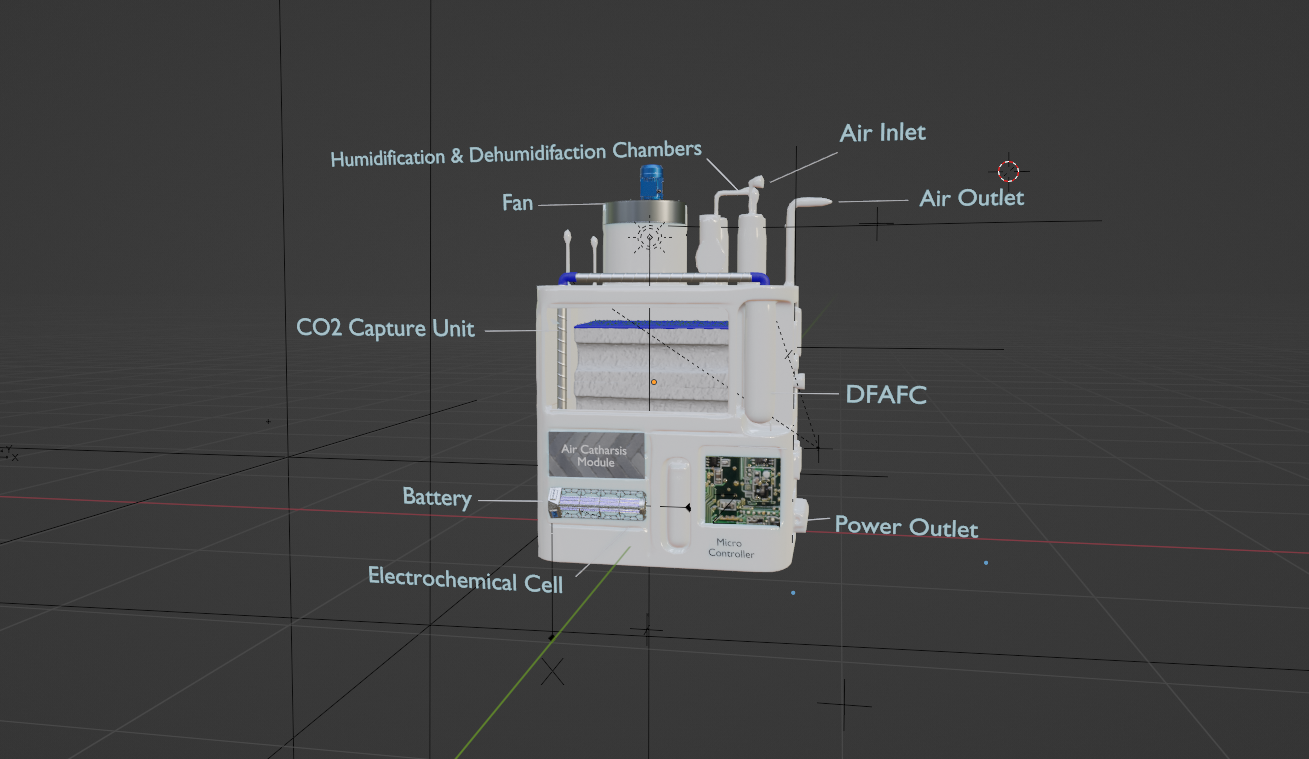
Complete system architecture showing all integrated components
CO₂ Capture Module
$$\text{CaO} + \text{H}_2\text{O} \rightarrow \text{Ca(OH)}_2$$
$$\text{Ca(OH)}_2 + \text{CO}_2 \rightarrow \text{CaCO}_3$$
This humidity-assisted pathway improves sorption efficiency while operating at room temperature.
Regeneration - Humidity Swing
$$\text{CaCO}_3 \rightarrow \text{CaO} + \text{CO}_2$$
Dry air shifts the chemical equilibrium, regenerating CaO without requiring high-temperature calcination—dramatically reducing energy consumption.
Indigenous Innovations
• Layered melamine foam with graded pore sizes for optimized airflow • Sensor-driven airflow control based on temperature and humidity • Gravity-assisted airflow routing
Electrochemical Conversion Module

Electrochemical Cell Design for CO₂ Conversion to Formic Acid
$$\text{CO}_2 + 2\text{H}^+ + 2e^- \rightarrow \text{HCOOH}$$
ANODE REACTION:
$$2\text{H}_2\text{O} \rightarrow \text{O}_2 + 4\text{H}^+ + 4e^-$$
Cell Design Innovations
• Membrane-less microfluidic electrochemical cell
• Tin-based electrodes for cost efficiency
• Potassium bicarbonate electrolyte to enhance CO₂ solubility
• Direct coupling to downstream fuel cell via microchannels
This eliminates the need for expensive membranes and intermediate storage.
Power Generation Module
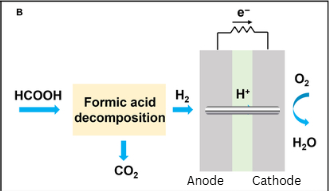
Power Generation with Proton Exchange Membrane (PEM) Technology
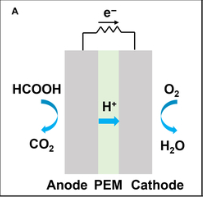
Advanced Power Generation and Energy Distribution
The Power Generation Module converts the energy produced by the electrochemical cell into usable electrical energy. This innovative system captures the voltage differential created during the conversion process and transforms it into power that can support the overall system operation or feed back into the grid. Key Features: • High-efficiency energy conversion • Real-time power monitoring • Scalable architecture for multiple cell configurations • Integration with grid-tie systems
Fuel Cell Advantages
• Direct coupling minimizes energy losses
• Generates electricity to partially or fully power the air purifier
• Excess electrons can power external circuits
System Flow Summary
$$\text{CO}_2 \rightarrow \text{HCOOH} \rightarrow \text{Fuel Cell}$$
ELECTRICITY FLOW:
$$\text{Chemical Energy} \rightarrow \text{Electrical Energy}$$
Performance Metrics
• VOC removal: up to 92%
• NOx removal: up to 85%
• Energy consumption: 20–30 W/hour
• Carbon footprint reduction: ~30% compared to conventional purifiers
Potential NO₂ Catharsis
$$\text{NO}_2 + \text{H}_2\text{O} \rightarrow \text{HNO}_3$$
$$\text{CaO} + 2\text{HNO}_3 \rightarrow \text{Ca(NO}_3)_2 + \text{H}_2\text{O}$$
This offers a pathway for additional NOx mitigation.
Challenges & Solutions
CHALLENGES
1. Long-term CaO stability
2. CO₂ release during regeneration
3. Scaling electrochemical cells
SOLUTIONS
• Doping CaO with Al₂O₃ / ZrO₂ to prevent sintering
• Partial CO₂ recirculation and algae bioreactor integration (future scale)
• Modular microfluidic electrochemical design
Implementation & Impact
IMPLEMENTATION
• Plug-and-play module for existing air purifiers
• Standalone CO₂ catharsis unit
• Compact, replaceable cartridge design
IMPACT
• Improved indoor air quality
• Decentralized CO₂ mitigation
ALIGNED SDGs:
• SDG 3: Good Health and Well-being
• SDG 7: Affordable and Clean Energy
• SDG 13: Climate Action
Financial Viability
PROJECTED MARKET PRICE
• Household HVAC: $200/unit
• Premium/industrial: $500/unit
• Licensing: $10/unit royalty
PRODUCTION COSTS
• Prototype: $350–400
• Mass production: $150/unit
• Optimized materials: < $90/unit
PROJECTED PROFIT MARGIN: 40–50%
Future Vision
• Scale for HVAC and industrial systems
• Develop nanostructured CaO sorbents
• Advance electrocatalysts for higher efficiency
• Enable decentralized carbon capture worldwide
Clean air. Captured carbon. Recovered energy.