Real-Time Celestial Tracking & Prediction System
Physics-driven orbital mechanics and sky position computation
Overview
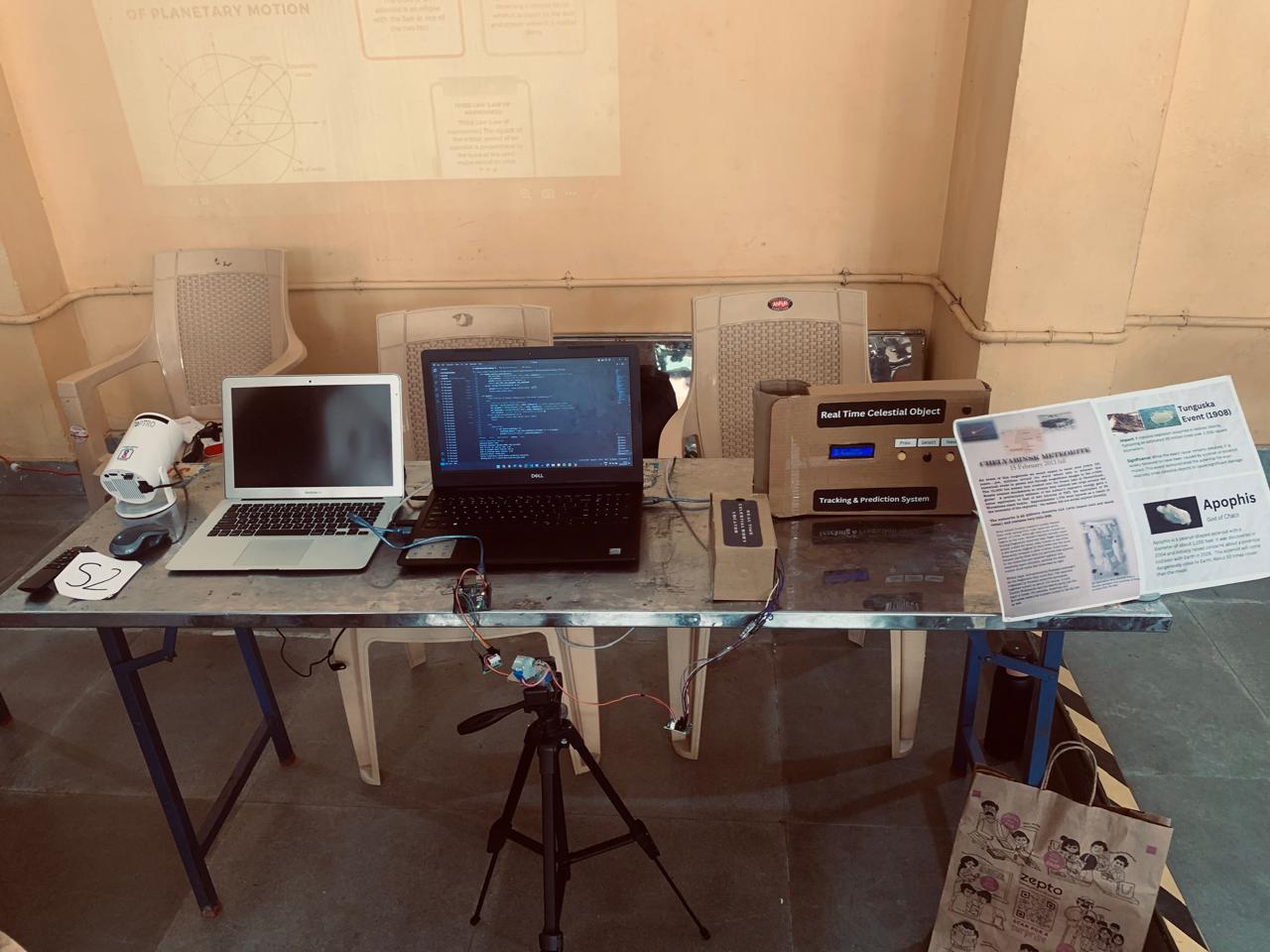
Real-Time Celestial Tracking and Prediction System Interface
The Celestial Body Tracking and Prediction System is a physics-driven computational model designed to track and predict the motion of celestial objects such as asteroids and planets in real time. The system combines classical orbital mechanics, numerical integration, and coordinate transformations to determine both future trajectories and observable sky positions.
Bala Vidya Mandir Interschool Award Winner (2024–2025)
Kepler's Laws of Planetary Motion
$$r = \frac{a(1 - e^2)}{1 + e \cos \nu}$$
Where: • r = radius vector • a = semi-major axis • e = eccentricity • ν = true anomaly
Kepler's Second Law
$$\frac{dA}{dt} = \text{constant}$$
Kepler's Third Law
$$T^2 \propto a^3$$
Newton's Law of Universal Gravitation
$$F = \frac{G m_1 m_2}{r^2}$$
Where: • G = gravitational constant • m₁, m₂ = masses of the two bodies • r = distance between their centers
This force governs orbital motion and acceleration.
Orbital Elements
The position and orientation of an orbit are fully described by six orbital elements:
• Semi-major axis (a): longest radius of the ellipse
• Eccentricity (e): deviation from circularity
• Inclination (i): tilt of the orbit
• Longitude of ascending node (Ω)
• Argument of perihelion (ω)
• True anomaly (ν)
Numerical Methods
$$\frac{d^2 \vec{r}}{dt^2} = -\frac{GM}{r^3} \vec{r}$$
RUNGE-KUTTA METHOD (RK4) The Runge-Kutta method is used to iteratively compute position and velocity over small time steps:
Runge-Kutta Integration
$$\vec{r}_{n+1} = \vec{r}_n + \frac{1}{6}(k_1 + 2k_2 + 2k_3 + k_4)$$
This ensures accuracy and numerical stability.
Perturbation Theory
$$\vec{F}_{\text{total}} = \vec{F}_{\text{primary}} + \sum \vec{F}_{\text{perturbations}}$$
Observational Data Fitting
$$\min \sum (O - C)^2$$
Where: • O = observed position • C = calculated position
Celestial Coordinate System
$$H = \text{LST} - \alpha$$
ALTITUDE CALCULATION:
$$\sin(a) = \sin(\delta)\sin(\phi) + \cos(\delta)\cos(\phi)\cos(H)$$
Where: • a = altitude • φ = observer latitude
AZIMUTH CALCULATION:
$$\sin(A) = \frac{\sin(H)\cos(\delta)}{\cos(a)}$$
Orbit Prediction Process
$$x = r \cos \nu, \quad y = r \sin \nu, \quad z = 0$$
STEP 2: VELOCITY (VIS-VIVA EQUATION)
$$v = \sqrt{GM\left(\frac{2}{r} - \frac{1}{a}\right)}$$
STEP 3: ORBIT PROPAGATION Using numerical integration, future position and velocity vectors are computed iteratively:
$$\vec{r}_{t+\Delta t}, \quad \vec{v}_{t+\Delta t}$$
Integration Methods
The system integrates multiple computational and observational approaches:
• ORBITAL DATA: Real-time ephemerides from NASA's Horizons System
• NUMERICAL COMPUTATION: Runge-Kutta integration for accurate trajectory predictions
• COORDINATE TRANSFORMS: Conversion from inertial to equatorial coordinates for sky position
• UNCERTAINTY QUANTIFICATION: Perturbation analysis to assess prediction accuracy
Final Output
The system produces a real-time sky map displaying:
• Celestial object position and apparent magnitude
• Trajectory prediction over 30+ days
• Observability windows (when the object is visible from a given location)
• Comparative analysis with historical orbital data
This output enables astronomers and educators to plan observations and verify orbital models.
Acknowledgements
Thank you for exploring our work. This project demonstrates how classical physics, mathematics, and computation combine to predict the motion of the universe with remarkable accuracy.